Home03 · The Chip LabAI & Smart Manufacturing
AI & smart manufacturing
The tool already knows it is about to fail. AI is how the fab listens.
Every semiconductor tool streams hundreds of sensor traces per wafer. For twenty years fabs have used that data for fault detection and statistical control. Machine learning extends the same loop: predict the drift, schedule the maintenance, catch the defect, plan the fab. The learning-by-doing rule still applies: start with one tool and its own data.
Interactive module 05 · from sensor to decision
One loop, packet by packet.
Watch the data leave the tool, pass through detection and analytics, become a decision, and return as an action. The loop is the product; the model is only one stage of it.
Yesterday: FDC and SPC
Fixed limits on sensor traces and control charts on wafer measurements. When a trace crosses a limit, the tool alarms; when a chart goes out of control, an OCAP tells the engineer what to do. I ran this at Infineon and ASE; it still catches most problems.
Today: prediction
Models trained on the tool's own history learn the signature of a failure days before the limit is crossed. Maintenance moves from calendar to condition. Virtual metrology estimates the result of a step without measuring every wafer.
Tomorrow: the fab as a model
Digital twins of tools, bays and utilities used for layout, hookup planning, capacity and energy. AI vision on every inspection image. Scheduling that reasons about the whole line. Still built one tool at a time.
Where it pays
Eight places AI earns its keep on a fab floor.
Predictive maintenance
Pump vibration, RF reflected power, valve cycle counts: the model schedules the PM before the failure schedules a down.
Advanced FDC
Multivariate models replace fixed limits, catching faults that no single sensor shows and cutting false alarms that train engineers to ignore alerts.
Virtual metrology
Predict film thickness or CD from tool traces, so metrology sampling drops and cycle time follows.
Yield analytics
Correlate wafer maps, tool history and test results to find the chamber, the recipe or the hour that hurt yield.
AI vision inspection
Defect classification on inspection and review images, and on packaged devices in the OSAT, faster and more consistently than human review.
Scheduling & AMHS
Dispatching, lot sequencing and overhead-transport routing optimised across the line, not one bay at a time.
Digital twin for build & hookup
Model the bay, the subfab and the utilities before the tool ships. Clash detection and hookup sequencing in software, not on the floor.
Energy & utilities
Optimise chillers, exhaust and compressed air against actual tool load. A fab's utility bill is a process, and processes can be controlled.
What I have done with it
From SPC charts on a test floor to AI-enabled manufacturing capability.
- Infineon & ASE (2004–2010): sustained product on line with SPC/FDC monitoring; test-time optimisation and yield management with the design team.
- HCL Technologies (2023–2025): directed AI-enabled semiconductor manufacturing capability development and digital-transformation initiatives supporting operational efficiency and engineering excellence.
- PTW India (2025–): fab automation, SECS/GEM integration and FDC connectivity as part of the equipment lifecycle services portfolio.
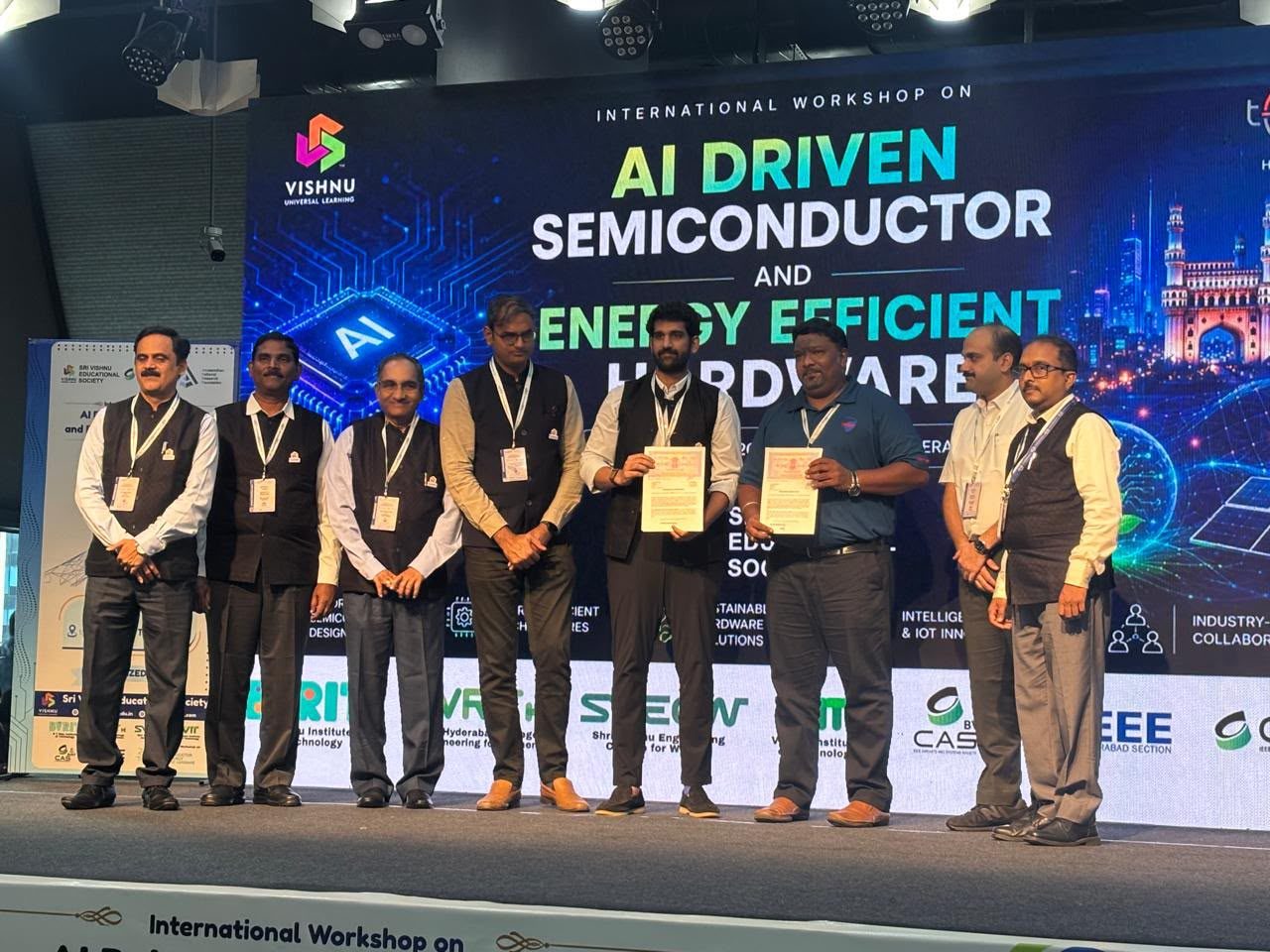
- Ecosystem: speaker and collaborator at industry-academia workshops on AI-driven semiconductor manufacturing.
Learning by doing, with data
How I teach smart manufacturing to engineers who have never trained a model.
- Start with one tool you already know
Pull a week of its FDC traces. Plot them. Find the PM in the data before you look at the log. The engineer learns that the tool has been talking all along.
- Label with the maintenance log
Mark the downs, the PMs and the recipe changes on the traces. Now there is a training set, and the engineer built it with domain knowledge no data scientist has.
- Build the simplest model that helps
A threshold on a derived signal beats a neural network nobody trusts. Prove one prediction on one chamber, then earn the right to scale.
- Close the loop on the floor
Write the OCAP for the prediction: who is paged, what they check, what they change. A prediction without an action is a dashboard.
- Teach it back
The engineer presents the loop to the module team. The next engineer takes the next tool. That is how a fab becomes smart: one trained person at a time.